 Annual Report 2025-26
The Risk Management framework focusses on ensuring that business risks are identified, evaluated and mitigated on a timely basis and reasonably addressed to protect the interests of all the stakeholders.
Northern Arc continues to place strong emphasis on risk management. Prudent risk management practices are integral to the Company’s operations, and we maintain high underwriting standards. Our well-structured risk management policy addresses the various risks that the business is exposed to, on account of being in the lending business. The Company’s Risk Management Policy of the Company seeks to identify, assess and monitor various risks.
We leverage machine learning-driven underwriting models, which is complemented by our continuous field monitoring. Over the years, we have built a robust data ecosystem comprising of over 50 Million data points enabling development of 30-plus underwriting models across our businesses. Our risk framework is further strengthened by dedicated team of 100-plus professionals.
In addition to centralised technology-led monitoring, our risk undertakes on-ground visit of nearly one-third of districts where we and our partner operate each year, providing valuable insights in local market dynamics and emerging risk. To put it in context, our portfolio is spread at about 680 districts and that means we cover over 220-odd districts in detail, visiting multiple partners and our own branches network giving us a far more granular touch and feel of what’s happening in the market.
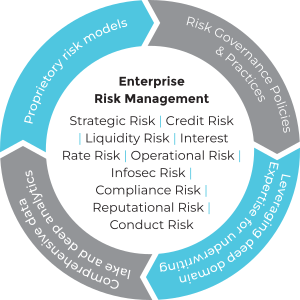
 Transaction Loss Modelling
 Portfolio Scrub Analysis
 Pin code Analysis
 Descriptive Analysis
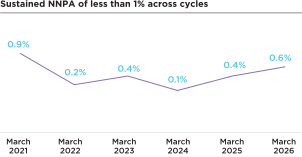
The Company also follows a conservative provisioning policy. We make 100% provisions on 90-plus days past due for all unsecured retail loans. While this approach may lead to relatively higher near-term credit cost compared to peers, it materially reduces the carry forward delinquent pool and lowers further provisioning requirement. These initiatives have resulted in resilient and well-diversified loan book with net NPA consistently being maintained below 1% over the years.
During FY26, the RBI issued guidelines on the treatment of Default Loss Guarantee in the computation of ECL, permitting NBFCs to factor in cash collateral as FLDG. This aligned the regulatory approach with Ind AS requirements. As a prudent measure, the Company also created a management overlay for potential unforeseen events.
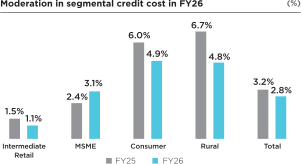
We further strengthened our collections capability through the implementation of a robust Collection Platform, enhancing tracking, improving field force productivity, enabling sharper delinquency monitoring, and supporting data-driven recovery strategies. We believe this will further improve collection efficiency, strengthen portfolio quality, and support scalable growth across the retail lending segment.